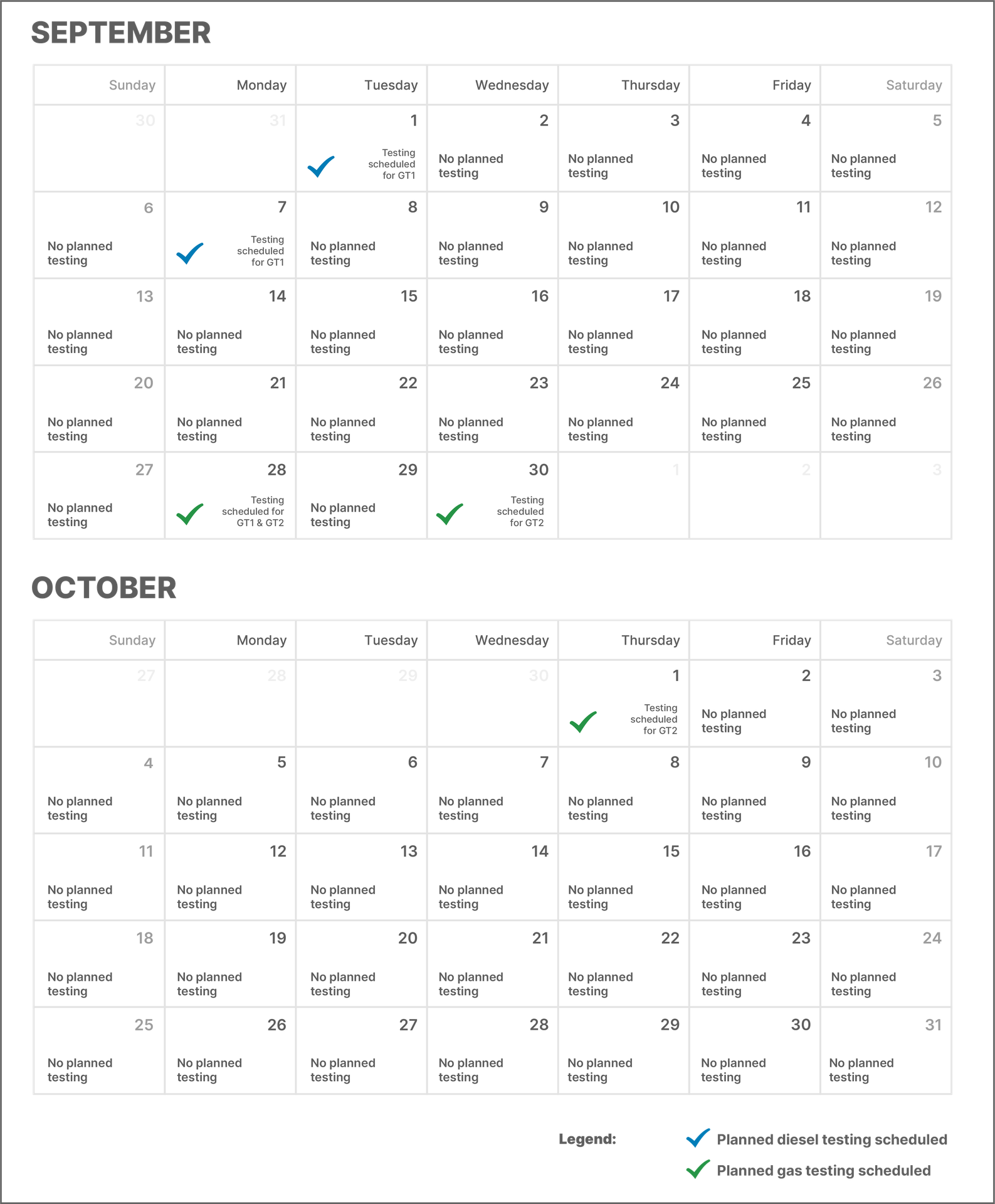
What the calendar shows
The schedule is published as an image rather than as text, which is why it has to be read
rather than searched. It covers September and October 2026 and carries a two-line legend: a
blue tick means Planned diesel testing scheduled
and a green tick means
Planned gas testing scheduled
.
| Date | Marked as | Unit |
|---|---|---|
| Tuesday 1 September | Planned diesel testing | GT1 |
| Monday 7 September | Planned diesel testing | GT1 |
| Monday 28 September | Planned gas testing | GT1 and GT2 |
| Wednesday 30 September | Planned gas testing | GT2 |
| Thursday 1 October | Planned gas testing | GT2 |
Every other day shown across the two months is marked
No planned testing
. The calendar’s own note says
This testing schedule is subject to change. The schedule above will be updated
regularly.
Two things follow from that table, and both are worth stating carefully.
The diesel window was shorter than the one published in August. The August schedule showed diesel testing on GT1 resuming 31 August and running to 9 September. On the calendar published now, diesel appears on 1 and 7 September and nowhere else.
The last three marked dates are gas, not diesel. After 7 September the schedule returns to gas testing on 28 and 30 September and 1 October, and then stops. For a neighbour, that means the calendar as it stands has exactly one date left on it.
What this does not tell you
It does not say the commissioning is over. It does not say the diesel testing succeeded, and it does not say it was deferred. Those are the two obvious readings of a diesel phase that shrinks and then gives way to gas, and the page chooses neither. We are not going to choose for it.
The page is also carrying two things that disagree. Its Key dates
section is stamped
30 September 2026, but the prose above it still describes the August plan,
telling readers that testing is due to restart next week, with a run on the primary gas fuel on Monday 31 August to prepare for diesel testing on Tuesday 1 September
. That sentence was accurate when it was written. It is not a description of where the project is now, and the calendar beside it is the part that has moved.
On the visible plume that prompted much of the local concern, the page carries one
sentence and we quote it without adding to it:
The impacts of our recent testing is currently under investigation and we will communicate as required in due course.
The standing numbers, unchanged
Two figures on the same page define what this station is, and neither has moved. It will
provide 660 megawatts when called on. And it is a peaker, which the
page puts in a single sentence:
Approval has been granted for the power station to operate up to 12.5% of the year or 1100 hours.
It adds that the expectation is it will operate for a lesser period of time
.
That cap is the thing to hold on to when this station is described, in either direction, as a large addition to the grid. Up to 1,100 hours in a year is up to about one hour in eight, and the operator expects less.
If you live near it
The page publishes a line that is worth having to hand, and it is staffed around the clock during this phase: a community hotline on 1800 570 529, described as 24 hours a day and seven days a week, for immediate issues or complaints, with an email address beside it. If you experience odour or noise from overnight testing, that is the number the operator asks you to use, and a call on the night is worth more than a complaint a week later.
What we will check
Whether the calendar gains October dates, and whether the page ever states plainly that diesel testing is complete. We have now read this schedule four times since July and the useful thing each time has been the image rather than the words around it, so that is where we will keep looking.